What 'E-Girl' Actually Means in 2026: The Culture, Explained
The word 'e-girl' gets used a hundred ways and defined none of them well. Here's where the label came from, what it means in 2026, and why gaming sits at the center of it.
Type “e-girl” into a search bar and you’ll get a hundred definitions, most of them half-joking and most of them wrong. The word has drifted a long way from where it started, picked up a few insults along the way, and quietly turned into something people now claim on purpose. So it’s worth doing the unglamorous thing and actually defining it.
What “e-girl” actually means
At its simplest, an e-girl is someone whose identity is built online first. The look is the part everyone recognizes: dyed hair in split colors, heavy blush swept high on the cheeks, sharp eyeliner, sometimes a little drawn-on heart or a fake freckle, layered over alt and streetwear-adjacent fashion. But the aesthetic is only the surface. What actually makes an e-girl is where she lives, which is streaming platforms, Discord servers, and the feeds that connect them.
That’s the honest answer to what “e girl” means in 2026. It’s not a single outfit and it’s not a personality type. It’s an online-native identity with a recognizable visual language attached, closer to a subculture than a costume.
The look didn’t come from nowhere
The aesthetic borrows openly. You can see scene and emo hair from the late 2000s, Japanese street fashion, anime color palettes, and a heavy dose of early-2020s TikTok makeup all stacked together. None of it is new on its own. What’s new is the combination, and the fact that it was assembled in public, on camera, one stitch and duet at a time.
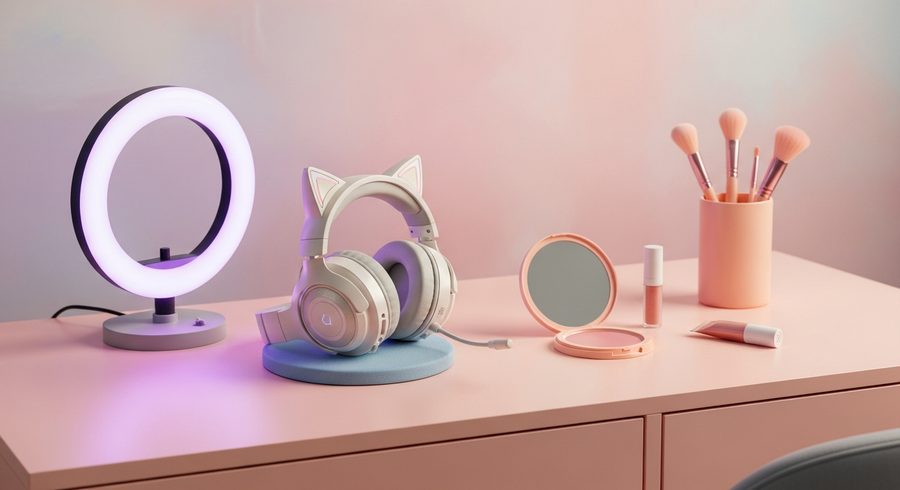
That public assembly matters. An e-girl look is meant to read on a webcam and a phone screen, not across a crowded room. The high blush, the exaggerated eyeliner, the ring light glow: all of it is tuned for the exact resolution most people will ever see it at.
The gaming roots of the e-girl gamer
Here’s the part the fashion write-ups tend to skip. The e-girl aesthetic grew up on Twitch and in gaming Discords, not on a runway. The archetype of the e girl gamer, headset on, RGB behind her, mid-match, is genuinely where a lot of this crystallized.
Competitive titles did the heavy lifting. Valorant and League lobbies, Minecraft SMPs, and the endless churn of whatever game was trending gave the look a native habitat and an audience that understood it instantly. Streaming turned personal style into a brand, and the brand rewarded a distinct, camera-ready face. The aesthetic and the platform shaped each other.
This is also why the label carries a chip on its shoulder. Women who streamed games got called e-girls as a way to imply they were performing rather than playing, that the look was a hustle and the skill was fake. Plenty of them answered by simply being very good at the game, on camera, for years. The insult aged badly.
”E-girl games” and the aesthetic online
Search “e girl games” and you’ll trip over two completely different things wearing the same phrase.
The first is a whole genre of browser-based avatar and dress-up creators, the kind of tool people open to build an e-girl look before they commit to it in real life. Pick the hair, the blush, the fits, screenshot, repeat. They function like a low-stakes fitting room for the aesthetic.
The second meaning is the games the community actually plays, which is a moving target by design. It leans toward Valorant, League, Minecraft, cozy and life-sim titles, and whatever’s dominating Twitch that particular month. There’s no official canon. The list is just wherever the community happens to be hanging out.
How the label grew up by 2026
The biggest shift isn’t the eyeliner. It’s the tone.
“E-girl” started life as something said about people, usually to needle them. By 2026 it’s mostly something people say about themselves, and they mean it plainly: this is my style, this is where I spend my time, this is the corner of the internet that feels like home. The reclaiming happened the way it usually does, quietly, through sheer repeated use, until the sneer wore off the word.
The look has also fractured into softer offshoots, more pastel, more cozy, less edge, which is what happens to any aesthetic that sticks around long enough to have subgenres. That’s not dilution. That’s a subculture doing what subcultures do when they stop being a trend and start being an identity.
So the next time the term shows up in your feed, you can skip the hundred bad definitions. An e-girl is an online-native identity with a shared visual language and deep roots in gaming culture. Everything else is just which version of the look someone happens to be wearing.
What does e girl mean in 2026?
An e-girl is someone whose identity is shaped online first: an alt-leaning aesthetic (dyed hair, blush, layered fashion) plus a life lived across streaming, Discord and social platforms. In 2026 it reads less like an insult and more like a self-chosen style, closer to a subculture than a costume.
Is an e-girl the same as an e girl gamer?
There's heavy overlap. The e-girl look grew up on Twitch and in gaming Discords, so plenty of e-girls are also streamers or competitive players. But not every e-girl games seriously, and plenty of women who game hard would never call themselves e-girls. The two labels touch, they don't equal each other.
What are 'e girl games'?
Two different things share that search. One is browser-based avatar and dress-up creators people use to build an e-girl look. The other is the games actually associated with the community, which skews toward Valorant, League, Minecraft, cozy titles and whatever's big on Twitch that month.
Is calling someone an e-girl an insult?
It started as one. By 2026 the community has largely reclaimed it, and most people who use it about themselves mean it as a neutral or affectionate description of a real online-native style.